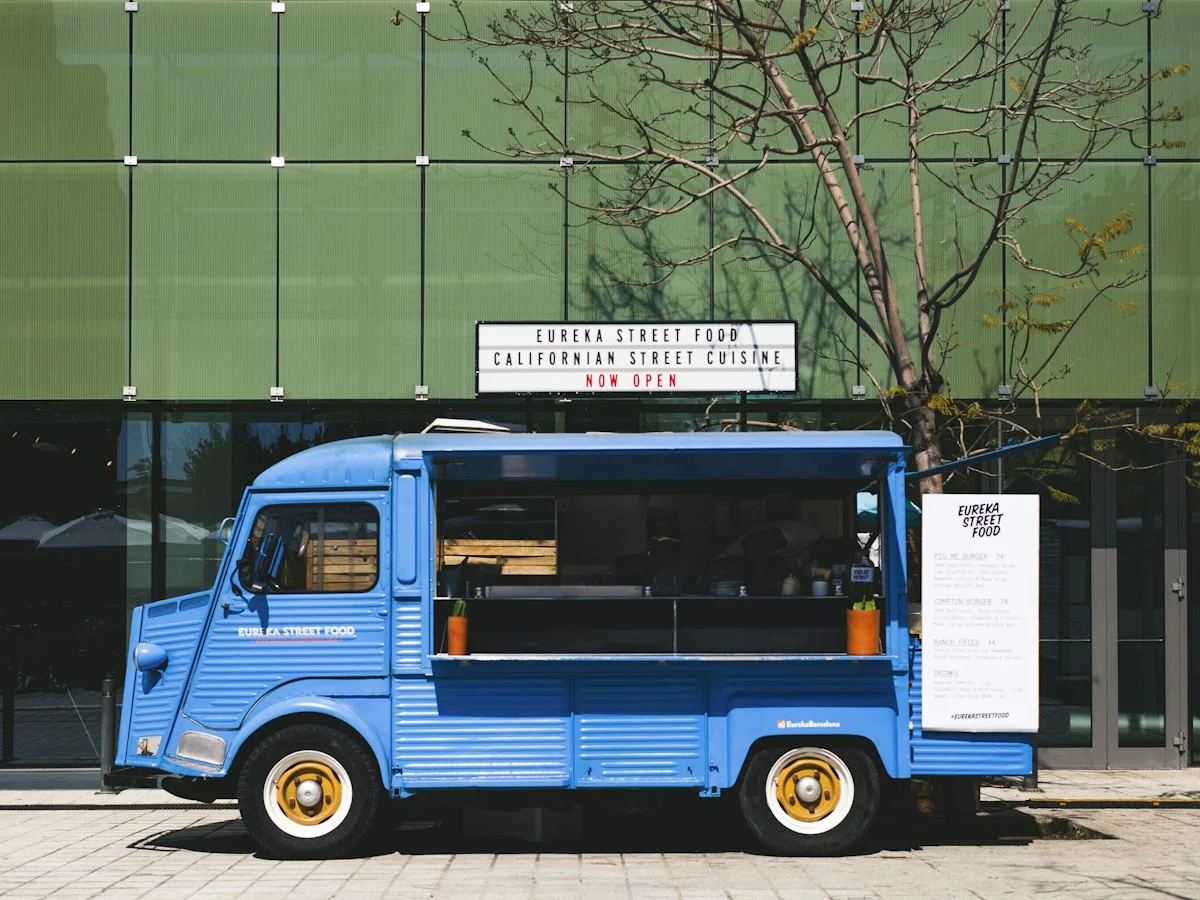
A food truck is tempting because the barrier to entry is lower than for a fixed venue: you don't pay rent for a dining room, you don't do a fit-out, and you can change where you sell. But a “cheap start” is relative. Budgets vary enormously: from a few tens of thousands of zloty for a used trailer to over two hundred thousand for a new vehicle with a kitchen.
Below we break the costs down into parts: the vehicle, kitchen equipment, paperwork, the start of sales and monthly running costs. The prices come from Polish sales listings and industry comparisons from 2025–2026 (list at the end). Treat them as ranges for planning, not a quote. Only an offer from a manufacturer or fit-out company will give you an exact amount.
Trailer or vehicle?
This is the first decision, and it affects the budget the most. A catering trailer is cheaper and simpler to maintain, but you need a vehicle that can tow it. A vehicle with a fitted kitchen is more expensive, but you can move faster and don't have to hitch anything.
| Catering trailer | Vehicle (food truck) | |
|---|---|---|
| Price new | empty 4×2 m: about PLN 19,000–35,000; with equipment: PLN 40,000–150,000 | with fit-out and equipment: PLN 150,000–200,000 |
| Price used | depends on condition and equipment | ready food truck: PLN 40,000–80,000; the van alone (e.g. Ducato, Sprinter): from about PLN 20,000 + conversion |
| Vehicle needed | yes, with a tow bar and enough towing capacity | no |
| Driving license | depends on the combination's maximum authorized mass (B, B with code 96 or BE) | usually B (up to 3.5 t) |
| Running costs | no engine, cheaper inspections and insurance | fuel, servicing, insurance and vehicle inspections |
| Good for | a fixed pitch, seasonal stands, events | frequent changes of location, food truck festivals, several pitches a week |
Prices of new trailers in 2026 listings start from about PLN 19,000 for an empty 4×2 m body and about PLN 30,000–35,000 for a trading and catering trailer with a basic fit-out. Industry comparisons give PLN 40,000 as the starting point for a trailer with basic equipment and PLN 70,000–150,000 for a version with a pizza oven, a hood, refrigeration and air conditioning.
Kitchen equipment
If you buy an empty trailer or convert a vehicle yourself, you count the equipment separately. What you need depends on the menu: burgers need a griddle and a fryer, pizza an oven, coffee an espresso machine and a grinder.
| Equipment | Indicative cost |
|---|---|
| Grill or griddle | PLN 4,000–10,000 |
| Fryer | PLN 2,000–6,000 |
| Fridges and refrigeration | PLN 3,000–8,000 |
| Sink with water heater | PLN 1,000–3,000 |
| Ventilation, sockets, lighting | PLN 5,000–15,000 |
| Cabinets and fit-out | PLN 2,000–5,000 |
| Total | PLN 15,000–40,000 |
| Generator (if you don't have a reliable power hookup) | PLN 3,000–8,000 |
The comparisons price converting the vehicle itself to sanitary requirements (steel sheeting, washable surfaces, installations) at PLN 20,000–40,000, and up to PLN 70,000 for an extensive fit-out.
When choosing equipment, think about power. An electric fryer, griddle and fridges at the same time can exceed the power you'll get at a festival. Ask the organizers how many kW they provide per stand, and choose your equipment (or gas) to suit.
Paperwork and what it costs
Registering the business itself is free. Since 2025 Poland has used a new PKD classification of business activities, and the right code for a food truck is 56.12.Z, “Mobile food service activities”. After that, the costs break down like this:
| Formality | Indicative cost |
|---|---|
| Registering a sole proprietorship (CEIDG) | PLN 0 |
| Approval of the vehicle by Sanepid (paperwork, inspection) | PLN 500–1,000 |
| Drawing up a HACCP system | PLN 500–2,000 |
| Sanitary and epidemiological medical tests for an employee | PLN 100–150 per person |
| Health and safety and HACCP training | PLN 200–300 per person |
| Fiscal cash register and card terminal | PLN 1,000–3,000 |
| Vehicle inspection and registration | PLN 300–1,000 |
A food truck is a food business like any other. Before you start selling, Sanepid (Poland's sanitary inspectorate) has to approve it and enter it in the register of establishments. The requirements for mobile food service are almost as strict as for a fixed venue: running water, handwashing, washable surfaces, proper food storage.
If you want to sell alcohol, you need a permit from the municipality. The fee depends on the type of alcohol and on the municipality. For outdoor events, one-off permits are usually issued.
Branding and the start of sales
A food truck is an advertisement in itself, so it isn't worth saving on its looks.
- Vehicle wrap: PLN 3,000–10,000
- Logo and graphic design: PLN 1,000–4,000
- First ingredients (for a few days): PLN 2,000–5,000
- Packaging, cups, napkins: PLN 1,000–2,500
- Workwear and cleaning products: PLN 500–1,500
What it costs to start: three example budgets
We added up the ranges above for three typical scenarios. “Paperwork” includes Sanepid, HACCP, the cash register and medical tests. “Start of sales” covers ingredients, packaging and workwear.
| Item | Used food truck | New trailer with equipment | New vehicle with fit-out |
|---|---|---|---|
| Vehicle with equipment | PLN 40,000–80,000 | PLN 40,000–150,000 | PLN 150,000–200,000 |
| Generator | included or none | PLN 3,000–8,000 | included or none |
| Branding | PLN 3,000–7,000 | PLN 3,000–7,000 | PLN 3,000–10,000 |
| Paperwork | PLN 2,000–6,000 | PLN 2,000–6,000 | PLN 2,000–6,000 |
| Start of sales | PLN 3,500–9,000 | PLN 3,500–9,000 | PLN 3,500–9,000 |
| Total | about PLN 49,000–102,000 | about PLN 52,000–180,000 | about PLN 159,000–225,000 |
Keep a reserve too. The first weeks usually bring unexpected expenses (a repair, extra equipment, a higher fee for a better pitch), while sales are only just picking up. It's safe to have money set aside for 2–3 months of fixed costs.
Monthly costs
This is where a food truck beats a venue: there's no rent for a dining room. Fixed costs still add up, though.
| Cost | Indicative per month |
|---|---|
| A fixed pitch or point of sale | PLN 500–3,000 |
| Fees for festivals and events | PLN 200–2,000 per day |
| Fuel, gas and running costs | PLN 500–2,500 |
| Insurance (liability, property) | PLN 100–1,000 |
| Accounting | PLN 300–800 |
| Marketing | PLN 200–1,000 |
| Ingredients and packaging | 30–35% of sales |
On top of that come the owner's contributions to ZUS (Poland's social insurance institution). In 2026 they look like this:
- Start-up relief (the first 6 months): you pay only the health insurance contribution. Its minimum is about PLN 433.
- Preferential ZUS (the next 24 months): about PLN 456 in social insurance contributions plus the health contribution.
- Full ZUS: at least about PLN 2,359 a month including the health contribution.
If you hire someone on an employment contract, the minimum wage in 2026 is PLN 4,806 gross. The total cost to the employer is about PLN 5,790 a month.
An example calculation: does it add up?
Take a food truck at a good pitch in season: 50 customers a day, an average bill of PLN 35 net, 20 trading days a month. That's PLN 35,000 of net sales.
| Item | Amount |
|---|---|
| Net sales | PLN 35,000 |
| Ingredients and packaging (32%) | −PLN 11,200 |
| An employee on a contract (cost to the employer) | −PLN 5,790 |
| Owner's ZUS (full) | −PLN 2,359 |
| Pitch | −PLN 1,500 |
| Fuel, gas, electricity | −PLN 1,500 |
| Accounting, insurance, marketing | −PLN 1,300 |
| Left before income tax | about PLN 11,350 |
This is an example, not a forecast. The numbers change with the weather, the pitch and the season. In winter many food trucks sell a fraction of their summer turnover, so it's worth calculating the whole year, not just July. You also repay the investment from this amount. With a budget of PLN 100,000 and a result like this, payback will take at least a good few months, and realistically more like two seasons.
How to lower costs and risk
- Start with a used vehicle or trailer. A new food truck makes sense once you have a proven concept and places to sell.
- Check the vehicle with Sanepid before you buy. A used food truck may have been approved for a different menu. Ask what needs adapting for yours.
- Keep the menu short. A short menu means less equipment, smaller stocks, less waste and faster service at peak times.
- Secure fixed pitches, not just festivals. Festivals bring high turnover at weekends, but predictable income comes from a fixed weekday pitch: an office building, a campus, a housing estate.
- Take orders in advance. A queue is sales you lose when people walk away. Orders by phone or online with pickup at a set time spread out the peak and let you prepare for the rush.
Summary
The cheapest sensible start is a used food truck or a trailer with basic equipment, a budget of around PLN 50,000–100,000 including paperwork and the first purchases. A new vehicle with a fitted kitchen costs PLN 160,000–225,000. It makes sense when you know where and to whom you'll be selling. In every case location matters most: a good pitch with foot traffic will pay for expensive equipment, while a poor one won't help even the best kitchen.
Sources
- GoPOS: Food truck – what it costs to start and what the paperwork is (2025, in Polish)
- zamow.online: What does a food truck cost? (2025, in Polish)
- Świat Przyczep: How to open your own food truck – a guide for 2026 (in Polish)
- Otomoto: trading and catering trailer listings (2026, in Polish)
- EUR-Lex: Directive 2006/126/EC on driving licences (categories B and BE, code 96)
- iFirma: PKD codes 2025 – the changes from 2025 (in Polish)
- Poradnik Przedsiębiorcy: The minimum wage in 2026 (in Polish)
- Symfonia: ZUS contributions for business owners in 2026 (in Polish)